
Examples
Unconventional Spintronics from Chiral Perovskites
Traditional spintronic devices rely heavily on heterostructures with ferromagnets, which break time-reversal symmetry and have a non-vanishing net magnetization. These systems are primarily centered around magnetoresistive effects.
This post reports a work appearing in Advanced Functional Materials which investigates 2D hybrid organic-inorganic perovskites (HOIPs) as an alternative platform for unconventional spintronics. These materials feature zero net magnetization, with broken space-inversion and mirror symmetries are broken by structural chirality.
A major feature of chiral materials is Chiral-Induced Spin Selectivity (CISS), where an electrical charge current passing through a chiral geometry combines with spin-orbit coupling (SOC) to selectively generate a spin imbalance. This enables room-temperature operation with no applied magnetic field and without magnetic materials.
While CISS is a generic feature of chiral systems, the HOIPs are a little different: a chiral molecule is embedded in a perovskite host. In contrast to typical chiral systems, the electronic states of the chiral molecule do not carry current; the states that do are those of the perovskite host. However, since the chiral molecule imprints a chirality on the host, the states that carry the current are also chiral. Electronic structure calculations bear this out: states near the Fermi surface—the highest valence band (VB) and lowest conduction band (CB)—are heavily confined within the quasi-2D inorganic PbBr4 plane. It justifies focusing solely on the structural distortions of the inorganic PbBr4 host. From experiments we know imprinting works very effectively. HOIPs have a large advantage over more traditional CISS systems in that they are rigid, and are less subject to nuclear fluctuations.
Symmetry is the central concept used to understand the microscopic origin of the material’s unconventional spintronic properties. Symmetry analysis combined with electronic structure calculations yields the “anatomy” of chirality, enabling an understanding how structural tuning, spin-orbit coupling (SOC), and orbital components dictate the spin-polarized band structures and transport properties.
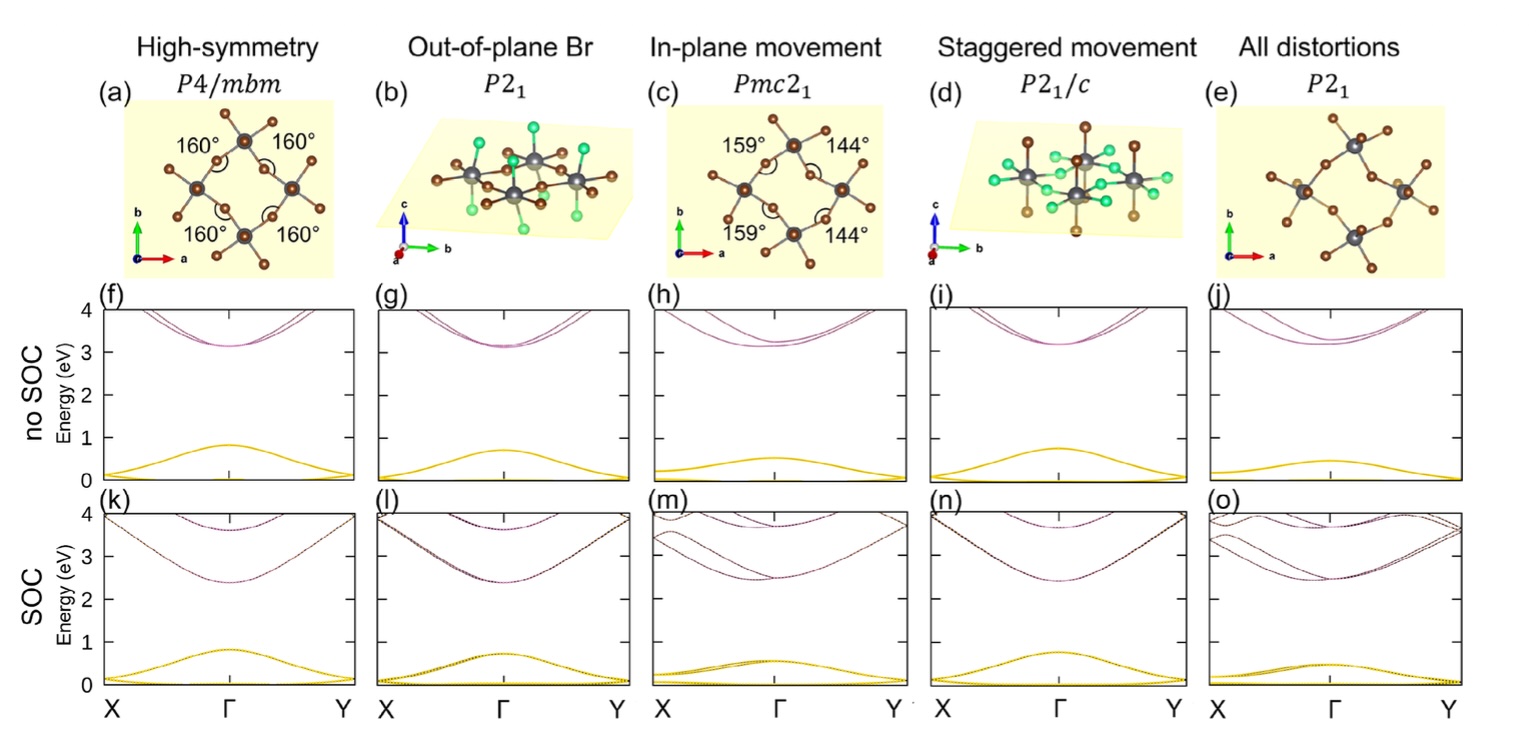 This work uses [R/S-NEA]2PbBr4 as a representative HOIP. and analyzes different ways in which the high-symmetry parent (with space group P4/mbm) can be reduced. Rather than take all the symmetry lowering distortions together, the chiral system is taken out and particular displacements are introduced that reduce the full P4/mbm symmetry a reduced symmetry, and the effect on the energy band structure is considered. The different kinds of symmetry reductions do very different things. For example, reduction to the Pmc21 symmetry entails the tilting of Pb-Br-Pb bonds away from the ideal 180° octahedral diagonal within the xy-plane (in-plane displacement). It is the most dominant distortion near the Fermi level, and breaks space-inversion symmetry, which allows spin-orbit coupling (SOC) to lift spin degeneracy and enable Rashba effects. However CISS originates from the interplay between SOC and the lack of mirrors ymmetries. Because mirror symmetry is still preserved this distortion alone does not induce chirality. The full chiral symmetry breaking (reduction to P21) breaks all mirror symmetries, enabling the CISS effect to emerge.
Orbital Splitting vs. Spin Splitting
States near the valence band maximum respond very differently to states at the conduction band minimum. Therefore, the CISS effect will depend strongly on whether the system is doped p-type or n-type.
The valence band behaves like a single-orbital state. When space-inversion symmetry is broken under the Pmc21 P21</subs> space groups, it undergoes standard, relativistic Rashba-type spin splitting governed by SOC.
The conduction band is formed by degenerate Pb multi-orbital states protected by C4 symmetry in the high-symmetry structure. When the in-plane distortion breaks the C4 and space-inversion symmetries, a massive momentum-dependent orbital splitting occurs even without SOC. Under full chiral symmetry, the resulting large band splitting is dominated by this crystal-field orbital splitting rather than pure relativistic spin splitting, making the splitting magnitude vastly larger than that of the valence band.
Anisotropic Spin Textures and the Edelstein Effect
The low-symmetry P21 environment creates highly directional, anisotropic spin textures. Effective Hamiltonian models demonstrate that the Rashba effect dominates along one momentum axis (kx), while chirality governs the other (ky).
Furthermore, the broken symmetries lock the spin density perpendicular to the inorganic plane within two distinct conduction valleys along the Γ-X path. While the net spin polarization is zero at equilibrium, applying an in-plane electric field exploits the broken symmetry of the scattering kinetics ( momentum transfer between valleys), leading to a highly efficient and anisotropic Edelstein effect (charge-to-spin conversion).
Tunable Altermagnetism
Symmetry analysis is also used to link chiral perovskites to altermagnets. Symmetry breaking introduced by organic chiral linkers provides a platform to realize altermagnets, which are zero-magnetization materials characterized by nonrelativistic, momentum-dependent spin splitting. By substituting the central Pb atom in the octahedron with a magnetic ion showcasing antiferromagnetic order, one can superimpose spin selectivity driven by a spin-polarized Fermi surface, introducing unprecedented spin tunability.
QSGW Many-Body Framework
Using an advanced many-body approach (QSGW) combined with the Bethe-Salpeter equation (BSE) calculations an exciton was found with a very large binding energy (0.86 eV.) Real-space anatomy shows the exciton is overwhelmingly concentrated on intersite Pb-Pb transitions. This strong excitonic binding points to potential applications in advanced room-temperature spin-lasers and spin-amplifiers.
PAPERS · SPINTRONICS · SYMMETRY · CHIRAL PEROVSKITES · MANY BODY PERTURBATION THEORY