
Examples
Excitons in van der Waals antiferromagnetic phosphates and phosphites
National University of Singapore · LNCMI-EMFL · Université Grenoble Alpes · Université de Toulouse · National Laboratory of the Rockies · Charles University, Prague · King’s College London, London · Warsaw University of Technology · Polish Academy of Sciences
This post summarizes three related papers on excitons in van der Waals antiferromagnetic thiophosphate/thiophosphite materials, all using the QSGŴ many-body method (a vertex-corrected extension of quasiparticle self-consistent GW)
Atomically thin crystals and van der Waals heterostructures provide a tunable platform for coupling magnetic exchange, structural symmetry, and reduced dimensionality within a single materials class. The discovery of intrinsic magnetism in monolayer CrI3 and Cr2Ge2Te6 established a broader platform for magneto-optical spectroscopy in van der Waals compounds. Recent reviews emphasize that excitons in van der Waals magnets must be understood in terms of exchange, localization, and exciton binding on comparable energy scales trihalides, ligand-field excitations, dark-bright exciton structure, and magneto-optical responses depend sensitively on local coordination and magnetic order. Resonant inelastic x-ray scattering has reinforced the same message from a complementary angle by directly resolving local d–d excitations and their magneto-structural dressing in CrI3 and related systems. More recently, direct coupling between excitons, exchange splitting, and magnetic collective effects have been resolved in anisotropic and antiferromagnetic van der Waals magnets including CrSBr . Metal thio- and selenophosphates extend this landscape by combining low symmetry, mixed covalent-ionic bonding, and chemically tunable magnetic sublattices within a common layered framework. Within this family, members such as NiPS3, MnPS3, CoPS3, and AgCrP2S6, have established connections between local orbital character, spin–lattice coupling, and spin-entangled optical excitations. Here we report work on three of these compounds.
Mn1-xNixPS3 — Tailoring Photomagnetism via Chemical Substitution
Na, Radovskaia, et al. (Radboud University), under review in Nature Communications; preprint available here
Ultrashort optical pulses have opened access to coherent spin dynamics in antiferromagnets, enabling generation of terahertz magnons for high-speed spintronic and magnonic applications. Yet, it remains unclear why photomagnetic susceptibility, i.e. how strongly spins respond to optical excitation, varies across materials and can be enhanced. This work studies how doping MnPS3 with Ni2+ affects photomagnetic responses, using magneto-optical pump-probe (magnetic second-harmonic generation mSHG, magnetic linear birefringence mLB) plus QSGŴ theory. It demonstrates that targeted chemical substitution provides a route to tailoring photomagnetic susceptibility in the van der Waals (vdW) antiferromagnet MnPS3. In weakly photomagnetic MnPS3, even 10% incorporation of Ni2+ ions enhances coherent magnon generation by more than an order of magnitude while preserving the Néel-type magnetic ground state. Energy-resolved pump-probe measurements were also taken across the Mn1−xNixPS3 series. The study shows that this enhancement arises from resonant excitation of orbital- multiplet d-d transitions of Ni2+ dopants. In particular, efficiency is not set by absorption strength or by whether a transition is spin-flip. Instead the largest magnon amplitude is driven by resonant excitation of the weakly-absorbing Ni2+ 3A1g multiplet — more effective than either the strongly-absorbing 3T1g or the spin-flip Mn2+ 4T1g transition. The absence of any scaling with optical absorption rules out a heat-driven mechanism and identifies the dynamics as fundamentally nonthermal.
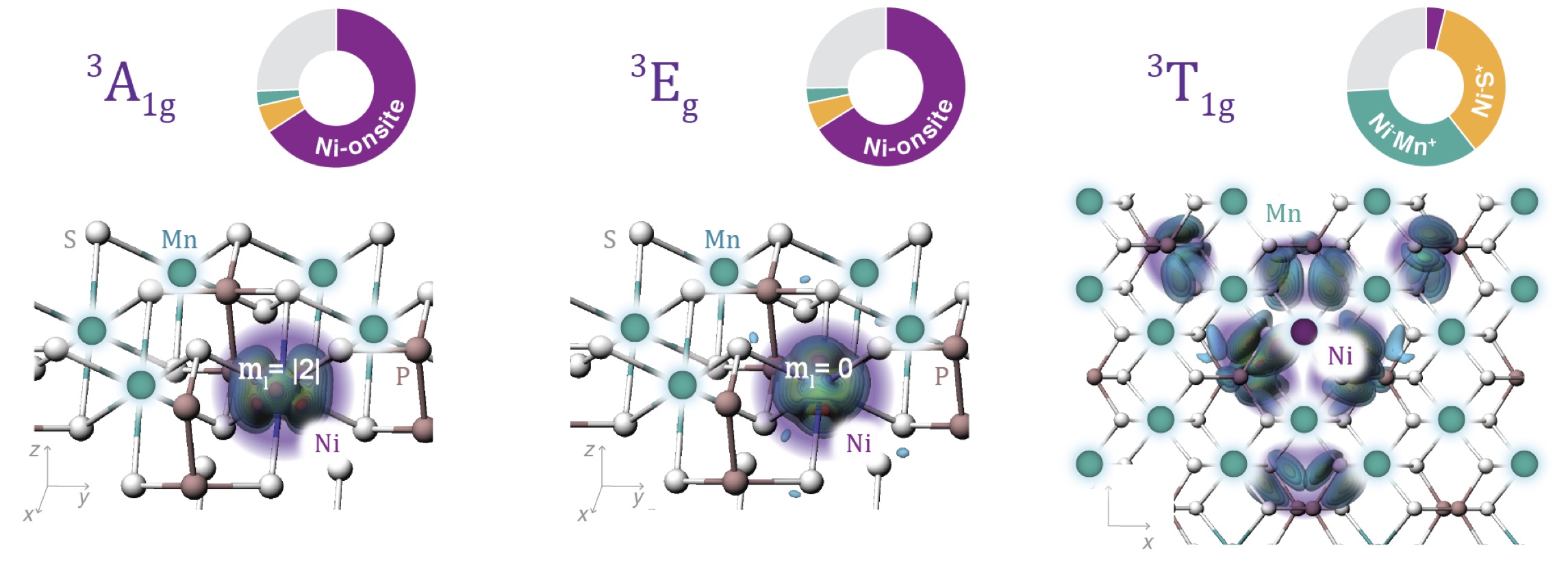 Fig. 1. 3A1g, 3Eg and 3T1g multiplets. The Ni and Mn ions are shown in purple and turquoise, respectively. S and P are shown in gray and brown. The 3A1g and 3Eg excitations are localized to the Ni-ion, while the 3T1g state is delocalized over multiple hexagonal plaquette. “m” labels the Ni d states (m=2 or m=0) onto which the 3A1g (3Eg ) excitation is projected.
Real-space excitonic wavefunction modeling reveals that the photomagnetic efficiency is dictated by strong on-site localization and orbital angular momentum of the excited states, not only by the associated absorption strength. Exciton visualization shows 3A1g and 3Eg are highly localized on Ni with large orbital angular momentum ( vs ), giving strong spin-orbit coupling to spins, whereas 3T1g is delocalized (S-p/Ni-Mn intersite character), reducing its orbital angular momentum and photomagnetic efficiency. These results establish transition-metal doping as a principal strategy to harness orbital multiplet excitations for ultrafast, low-dissipation photomagnetic control in vdW antiferromagnets.
Increasing Ni content also induces a spin-reorientation transition (~x=0.2) enabling helicity-dependent phase control of magnons, tied to Mn favoring out-of-plane vs. Ni favoring in-plane spins.
CrPS4 — Localized Excitons Tuned by Temperature and Magnetic Field
Jana et al (National University of Singapore), taken from this paper in Proceedings of the National Acadamy of Sciences
This work investigates the electronic and excitonic properties of bulk CrPS4 using a combination of many-body perturbation theory, dynamical mean-field theory, and photo-luminescence spectroscopy. Calculations establish CrPS4 as a direct-gap semiconductor with a bandgap of 2.48 eV in the antiferromagnetic phase. Theory also predicts a cluster of spin-allowed excitons near 1.4 eV plus a distinct spin-flip transition at 1.38 eV (from DMFT) These are predominantly localized on the Cr3+ ions. Temperature- and magnetic-field-dependent optical measurements reveal thermally driven exciton redistribution among localized states and identify characteristic energy shifts that provide clear optical signatures of magnetic phase transitions in CrPS4.
This work reinterprets features previously reported at ~1.4 eV (X1 and resonance F0): the community had assigned these to spin-flip 2E, 2T1 ↔ 4A2 transitions, interpreted as spin-flip transitions within the Tanabe–Sugano framework. n contrast, QSGŴ calculations reveal that most transitions near 1.4 eV are spin-allowed. The work also demonstrate that these transitions do not follow the characteristic temperature or magnetic field evolution expected for spin-flip exciton as reported for other MPXn materials.
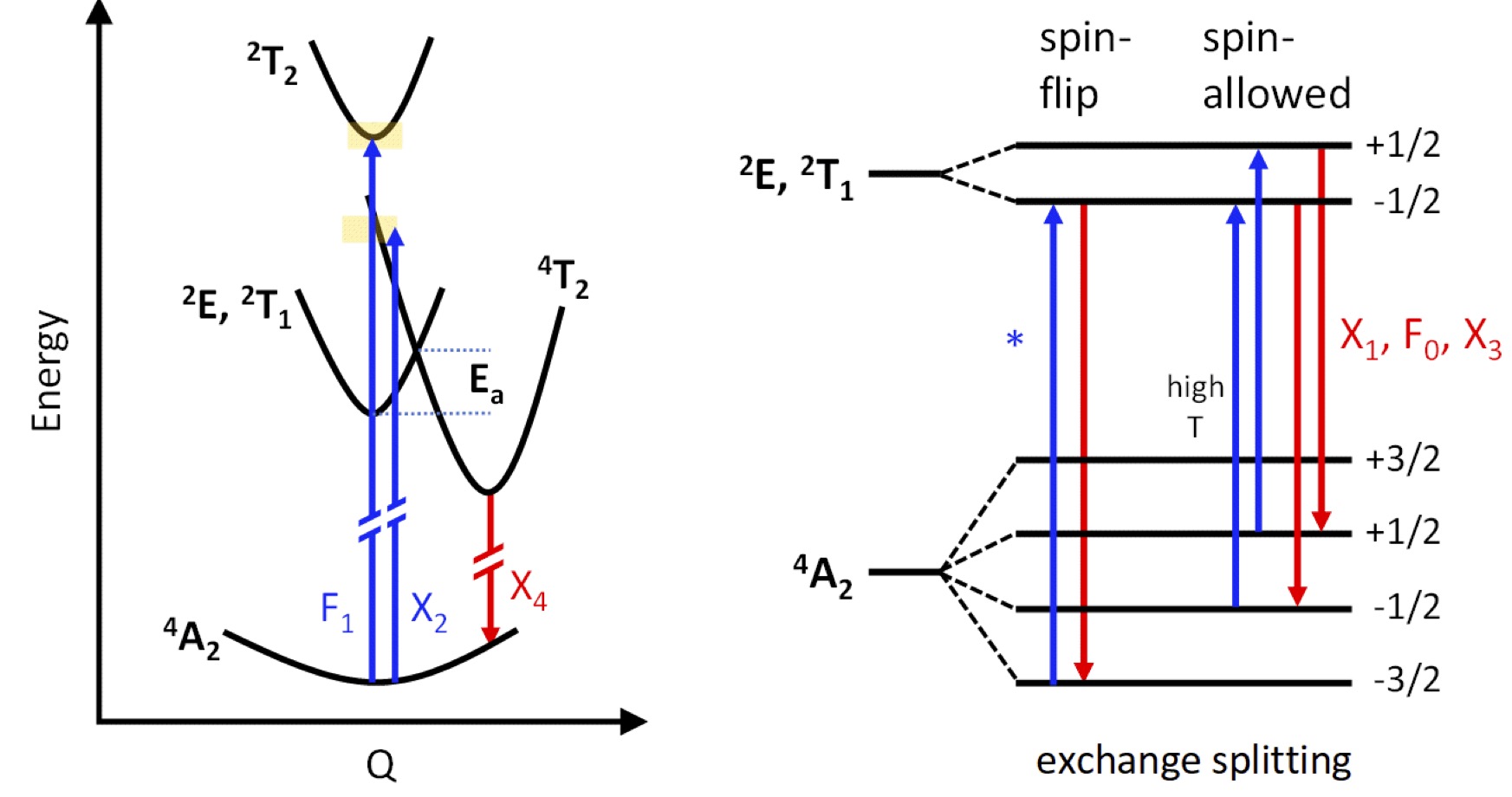 Fig. 2. Schematic configuration-coordinate diagram for the d3 electronic configuration and the exchange split levels of the 4A2 2E, 2T1 states. The localized d-d spin-flip and spin-allowed electronic excitations (emissions) are shown by blue (red) vertical arrows.
These results provide new insights into the excitonic transitions of antiferromagnets and suggest potential routes for all-optical sensing and light-driven control of their magnetic order.
AgCrP2S6, — Frenkel Excitons in a Mixed Ag/Cr Thiophosphate
McDivitt et al (NLR). Under review; preprint available here.
AgCrP2S6 combines a low-symmetry thiophosphate framework with an antiferromagnetic Cr sublattice and nonmagnetic Ag sites, providing a setting in which covalency and magnetic localization compete in the low-energy optical response. This work combines single-crystal x-ray diffraction, Raman spectroscopy, photoluminescence, lattice-dynamical calculations, and QSGŴ/BSE calculations to determine the structural, electronic, and excitonic properties of bulk AgCrP2S6. The material remains monoclinic between 100 and 300 K, with additional Ag- site disorder resolved at low temperature, and the optimized structure is dynamically stable. The QSGŴ calculations yield a reduced quasiparticle gap (2.19 eV) — smaller than in Cr trihalides owing to stronger p–d hybridization. Despite this covalency, the lowest exciton (XA, 1.42 eV) is best described as a weakly bright, strongly anisotropic Frenkel exciton with dominant on-site d–d character and substantial ligand-assisted d–p admixture (52% on-site d–d, 41% d–p, 7% intersite d–d), because the antiferromagnetic order and Ag dilution suppress intersite coherence.
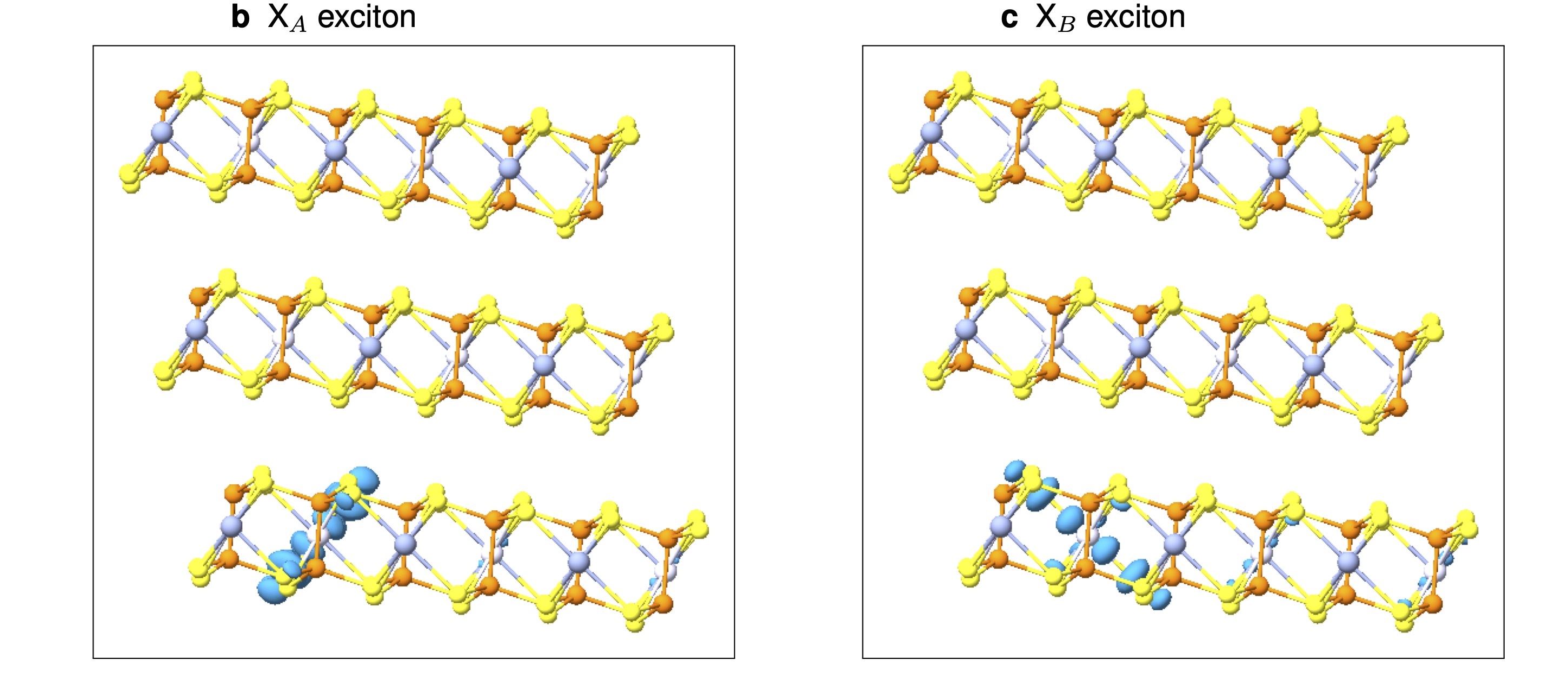 Fig. A. Real-space electron probability density for the representative AgCrP2S6 XA and XB excitons, respectively, with the hole fixed on a Cr site.
Symmetry analysis (C2h) assigns XA as a z-polarized, predominantly Bu state; exciton-phonon coupling channels are identified (Ag modes for diagonal renormalization, Bg modes for bright-dark mixing).
The XB exciton is only about 0.25 eV below the conduction band edge; it is therefore much more Wannier-like (consisting mostly of p-d character). Nevertheless it is comparatively short ranged, as Figure A shows.
Common thread: These papers use a common QSGŴ many-body framework to argue that in these van der Waals AFM thiophosphates, excitons remain predominantly Frenkel-like, with dominant on-site d-d character, despite significant ligand covalency, and that this localization — modulated by magnetic order, ion substitution, or dilution — controls optical brightness, phonon coupling, and photomagnetic response.
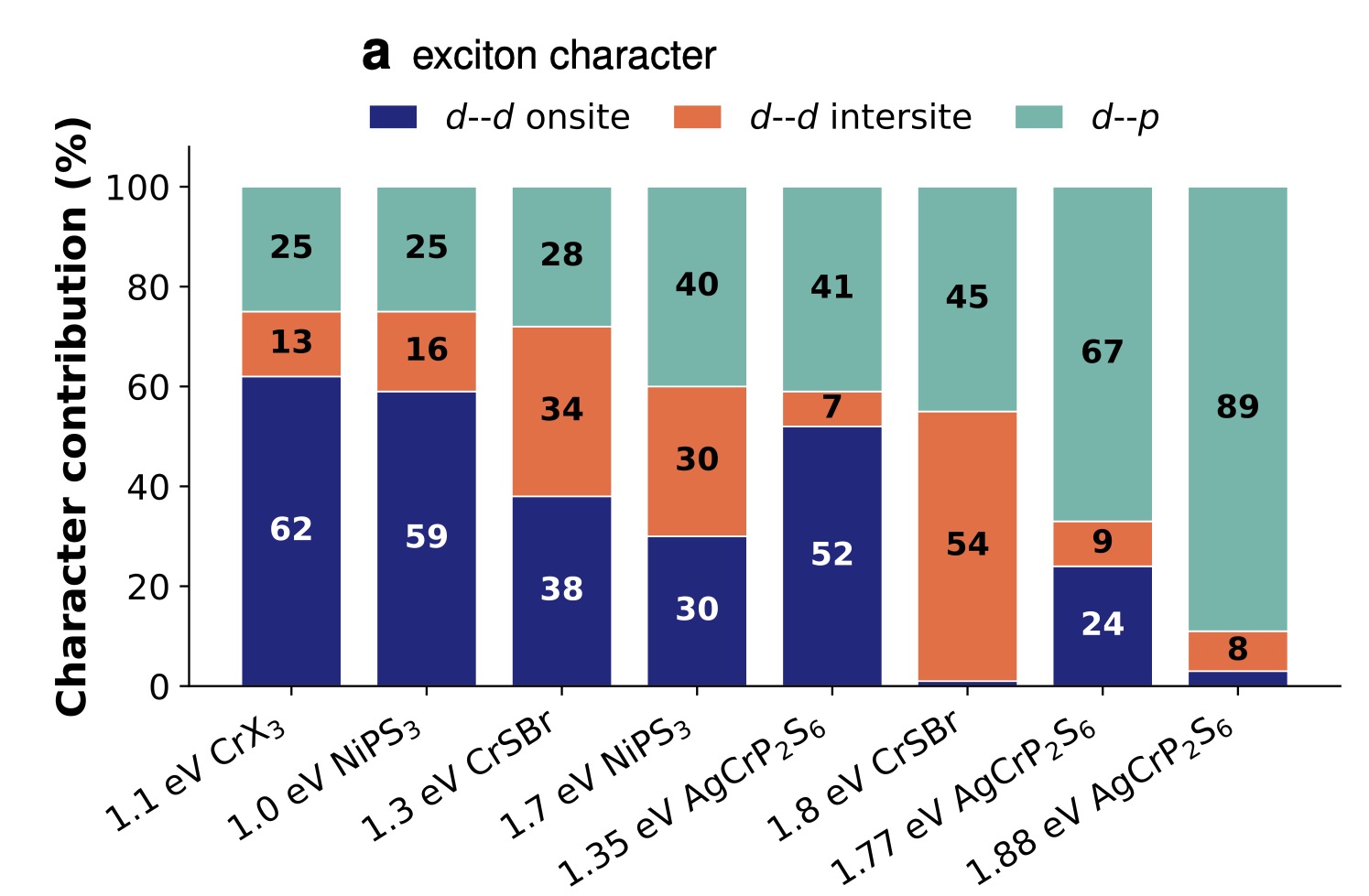 Decomposition of excitons into on-site d–d d–p and intersite d–d character, for several van der Waals 2D magnets.
PAPERS · OPTICAL RESPONSE · EXCITON-MAGNETIC INTERACTION · MANY BODY PERTURBATION THEORY · DYNAMICAL MEAN FIELD THEORY