
Examples
Coexistence of Frenkel and Wannier excitons in CrSBr
Śmiertka et al., Nature Communications, 2026 Wroclaw University · National Laboratory of the Rockies · LNCMI · University of Chemistry and Technology Prague · King’s College London · Technical University of Munich
We report on a recent work, published in Nature Communications, January 2026, that investigates two types of excitons (bound electron-hole pairs) in Chromium Sulphur Bromide (CrSBr), a 2D magnetic semiconductor. The central finding is that these two excitons – XA at 1.38 eV and XB at 1.8 eV – behave fundamentally differently because they belong to two distinct physical categories rarely coexisting in a single 2D material.
By pairing ultra-high-field magneto-optical spectroscopy (up to 85 Tesla) with an advanced ab initio many-body perturbation theory framework (), this work distinguishes the character of these two excitons. Typical 2D semiconductors host delocalized Wannier-Mott excitons, whereas magnetic insulators host highly localized Frenkel excitons localized around transition metal -orbitals. CrSBr bridges these two distinct regimes, showing two prominent excitonic features within the 1.3–1.9 eV spectral window:
- XA (at 1.38 eV) is Frenkel-like (localized), confined largely to a single chromium atom, with a binding energy of ~0.7 eV and a spatial extent of ~1.2 nm. The exciton is largely composed of on-site d-d transitions.
- XB (at 1.8 eV) is Wannier-Mott-like (delocalized), extending across multiple atomic sites, with a binding energy of ~0.3 eV and a spatial extent of ~4.5 nm. It is characterized by inter-site d-d and p-d dipolar transitions.
Difference in Magneto-Optical Sensitivity
The paper shows that the delocalized XB exciton is an order of magnitude more sensitive to magnetic field and lattice fluctuations than the localized XA exciton. Applying a sufficiently large field drives a transition from an interlayer antiferromagnetic (AFM) to ferromagnetic (FM) order, reducing the band gap by ~110 meV. This is because in the AFM phase, spin alignment prevents hybridization between layers, maintaining a higher band gap, while in the FM phase, uniform spin alignment eliminates this energy barrier.
XB redshifts by ~100 meV through this transition; XA shifts by only ~10 meV — a 10× difference. This is because XB is a Wannier-Mott exciton composed of states closely tracking the band edge, while the localized XA exciton is atomic like and remains largely unaffected by the environment.
The diamagnetic shift coefficient for XB (0.22 meV/T2) is ~4.4× larger than for XA (0.05 meV/T2), directly confirming XB’s greater spatial extent. Access to this high field regime provides one of the few ways to estimate the extent of an exciton. This experimentally determined ratio confirms the prediction of the excitonic structure by calculations.
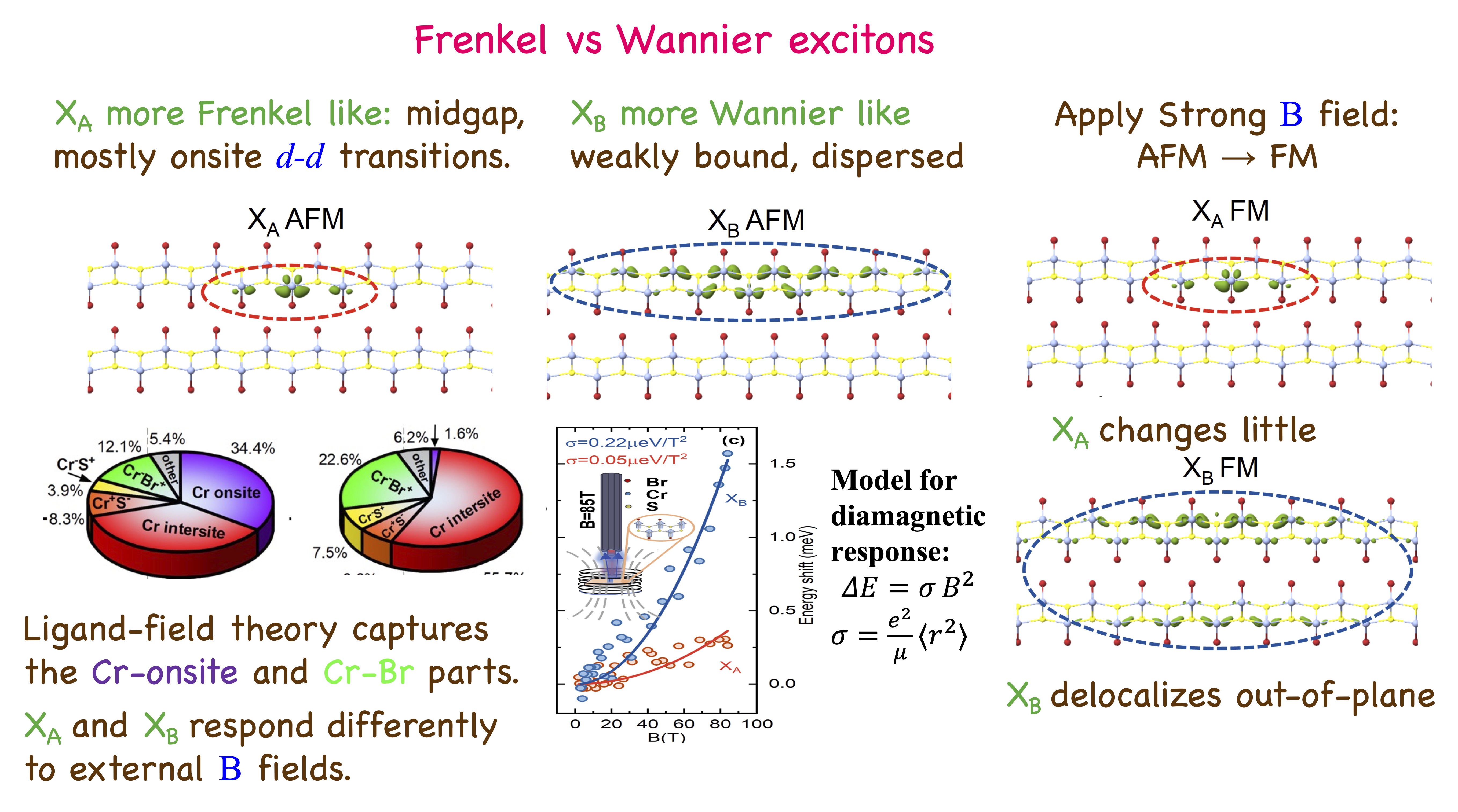
ISO-surfaces for the XA and XB exciton wavefunctions overlaid on the crystal structure in the AFM phase, showing exciton confinement within a single layer, but greater extent for the XB exciton. Pie charts show how the two excitons are distributed among intra and interatomic orbitals. Also shown are the excitons in the FM FM phase, revealing much stronger interlayer hybridization for the XB exciton. The diamagnetic susceptibility at high fields are very different for the XA and XB excitons, showing how one is tied to the host band structure and the other not, and also providing an estimate for the relative extent of the two excitons.
Temperature variations caused by exciton-phonon coupling
When investigating temperature dependencies (from 2 K to 110 K), the it was observed that the high field-induced redshift of XB decreases at higher temperatures (dropping from 110 meV to 85 meV), while XA remains temperature-independent.
Theoretical “frozen-phonon” calculations resolved the underlying cause: In the FM phase, the delocalized XB exciton expands vertically and extends into neighboring crystal layers. Frozen-phonon calculations show that out-of-plane Ag phonon modes (especially at 237 cm−1) are responsible — XB’s wavefunction extends out-of-plane in the FM phase, making it strongly coupled to these vibrations, while XA does not.
Experimental Setup:
Bulk CrSBr crystals were analyzed using magneto-reflectance spectroscopy across low fields (0–3 T) and pulsed ultra-high magnetic fields (up to 85 T) to observe pure diamagnetic shifts.
Theory:
The authors’ framework (Quasiparticle self-consistent GW with ladder diagrams) predicts a band gap of ~2.07 eV, This placed XA at 0.7 eV and XB at 0.3 eV below the conduction band minimum, proving their intermediate, coexisting nature. The theory consistent with recent photoemission experiments, and quantitatively reproduces many experimental observations of excitons; see for example this paper in Nature Materials.
Standard GW calculations based on density-functional theory predict a band gap of ~1.5 eV, which would make both excitons Wannier-Mott-like and miss the physics entirely.
Significance
CrSBr occupies an unusual intermediate regime where both Frenkel and Wannier-Mott excitons coexist in the same material, something not typically seen in 2D systems. This makes XB a highly sensitive optical probe of magnetic order, while XA acts as a stable reference. The work also demonstrates that conventional phenomenological models (ligand-field theory, Rydberg series) are inadequate for such correlated magnetic materials, underscoring the need for high-fidelity ab initio methods.
PAPERS · FRENKEL AND WANNIER EXCITONS · OPTICAL RESPONSE · EXCITON-MAGNETIC INTERACTION · MANY BODY PERTURBATION THEORY