
Examples
Electronic Structure of NiI2: ARPES and Theory
Watson et al., Diamond Light Source · Warwick University · Oxford University · National Laboratory for the Rockies
This post reports on the first detailed experimental study of the electronic structure of NiI2 using angle-resolved Photoemission spectroscopy (ARPES), combined with state-of-the-art Quasiparticle self-consistent GW (QSGŴ) calculations.
Layered transition metal halides have emerged as a fertile platform for exploring the interplay between reduced dimensionality, electron correlation, and magnetism. In particular, the electronic structure of NiI2 weaves together highly localized and correlated Ni 3d orbitals with delocalized and dispersive I 5p states. At the same time, the van der Waals nature of these systems makes them appealing for integration into heterostructures, where their magnetic and electronic properties may be tuned or exploited in device-relevant contexts.
- Experiment: The study used the template-stripped gold (TSG) method to obtain clean, low-charging surfaces of the air-sensitive, hygroscopic NiI2 crystals, and combined it with micro-focused ARPES at low temperature (25 K).
- Theory: QSGŴ calculations were performed assuming a simple ferromagnetic configuration in the high-temperature rhombohedral (R3̄m) structure, rather than modeling the true long-range spin-spiral ground state. Questaal can make both the noninteracting, “quasiparticleized” Green’s function G0, similar to energy band structures from density-functional theory or Hartree Fock theory, or the interacting one G, which lies outside a single Slater determinant picture (see this page). In this study, both are needed to interpret ARPES data.
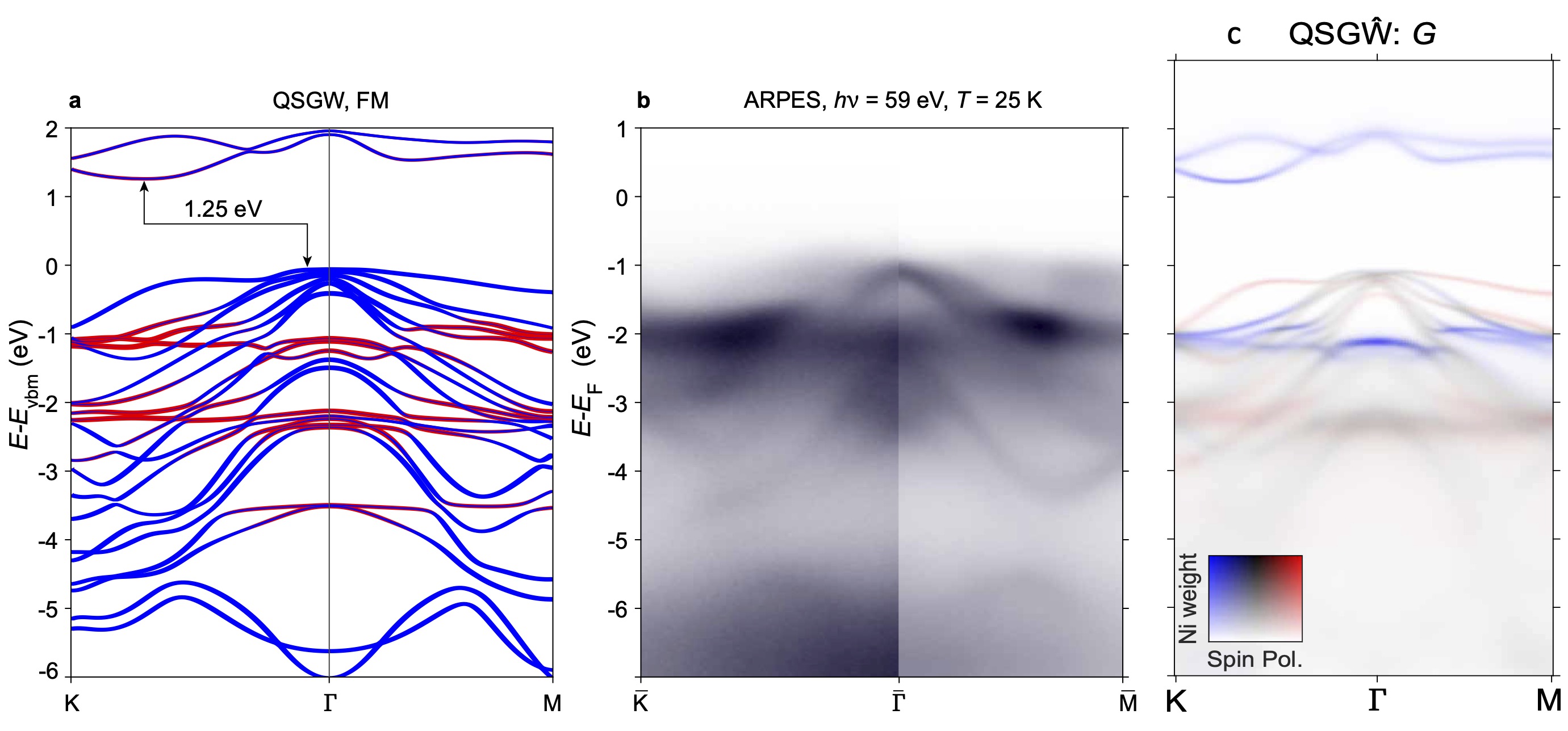 Fig. 1. ARPES data compared with QSGŴ spectral functions. a) The valence and lowest conduction bands from the noninteracting Green’s function G0. Red and blue lines represent the Ni and I band character respectively. The band gap is 1.25 eV. b) ARPES dispersion, stitching the K-Γ-M high symmetry cuts from two data sets. c) Similar to (a), but calculated from the interacting Green’s function G. For ARPES, the energy zero is referenced to the Fermi energy EF of the gold substrate.
Main Findings
Good agreement for I-derived bands: Dispersive valence bands with primarily iodine 5p character match QSGŴ calculations well, confirming NiI2 is a charge-transfer insulator (Zaanen-Sawatzky-Allen classification).
Band gap: The valence band maximum sits at −0.952 eV relative to the Fermi level, setting a lower bound of ~0.9 eV for the experimental gap — consistent with the calculated 1.25 eV gap and literature optical values (1.25–1.4 eV).
No signature of magnetic ordering: Despite NiI2’s two magnetic phase transitions (~60 K and ~75 K), the ARPES spectra show almost no temperature dependence — no backfolding, band shifts, or splittings — indicating the electronic structure is dominated by local Ni moments rather than long-range magnetic order.
Spin-selective coherence: While the Ni spin-minority t2g states appear as a bright, sharp, flat spectral feature (in excellent agreement with theory), the expected Ni spin-majority t2g states are essentially invisible experimentally, showing up only as broad, featureless background.
Analysis
The GW approximation already explains much of the spin-selective coherence observed in ARPES. Comparing G0 (Fig 1a) to the interacting G (Fig 1c), the flat, spin minority Ni d bands 2 eV below the VBM, get washed out in the interacting case, while the majority bands remain much sharper. The minority d states do not disappear completely at the GW level, and a heuristic many-body argument was developed to explain it. Photoemission final states differ dramatically for minority vs. majority spin removal. Removing a minority-spin electron leaves a high-spin d7 state that hybridizes favorably with a ligand-hole state (well-screened, coherent “main band”). Removing a majority-spin electron leaves a low-spin d7 state disfavored by Hund’s coupling, which can only mix with an unfavorable antiparallel ligand-hole configuration — leading to poor screening and incoherent, broadened spectral weight instead of a sharp band.
Significance
This effect is argued to be a general feature of Ni²⁺ compounds in octahedral coordination (drawing parallels to NiO), and similar spin-selective coherence can be expected to appear in related materials like NiPS3 and other Ni dihalides. The work also validates QSGŴ as superior method to describe this class of correlated magnetic materials.
PAPERS · ANGLE RESOLVED PHOTOEMISSION · MANY BODY PERTURBATION THEORY