Examples
The Nature of Excitons in Silica Glasses
Mazo et al., Colorado School of Mines · King’s College London · National Laboratory for the Rockies
This post describes an extension of an earlier study that introduced a new computational framework to simulate transport in amorphous systems, to the study of optical properties via the Bethe-Salpeter equation. It focuses on excitons (bound electron-hole pairs) in silica glass (SiO2), resolving long-standing challenges in modeling the optical properties of disordered materials.
Composite Representation: As with the earlier study of transport, the glassy state is modeled as an ensemble composite of small, local atomic domains generated via First-Principles Random Structure Sampling (FPRSS). Properties are evaluated by ensemble averaging over the properties of the individual local domains. In principle, the same result could be accomplished with massive supercells, but they are computationally expensive even in a mean-field theory such as density functional theory (DFT) or Hartree Fock theory, and prohibitively expensive when treated at the BSE level. 1,000 structures are generated and optimized at the DFT level. The model structure factor is in very good agreement with experiment (Fig. 1). Differences in intensity can be mainly associated with limitations imposed by the subset size and the number of atoms in the random structures.
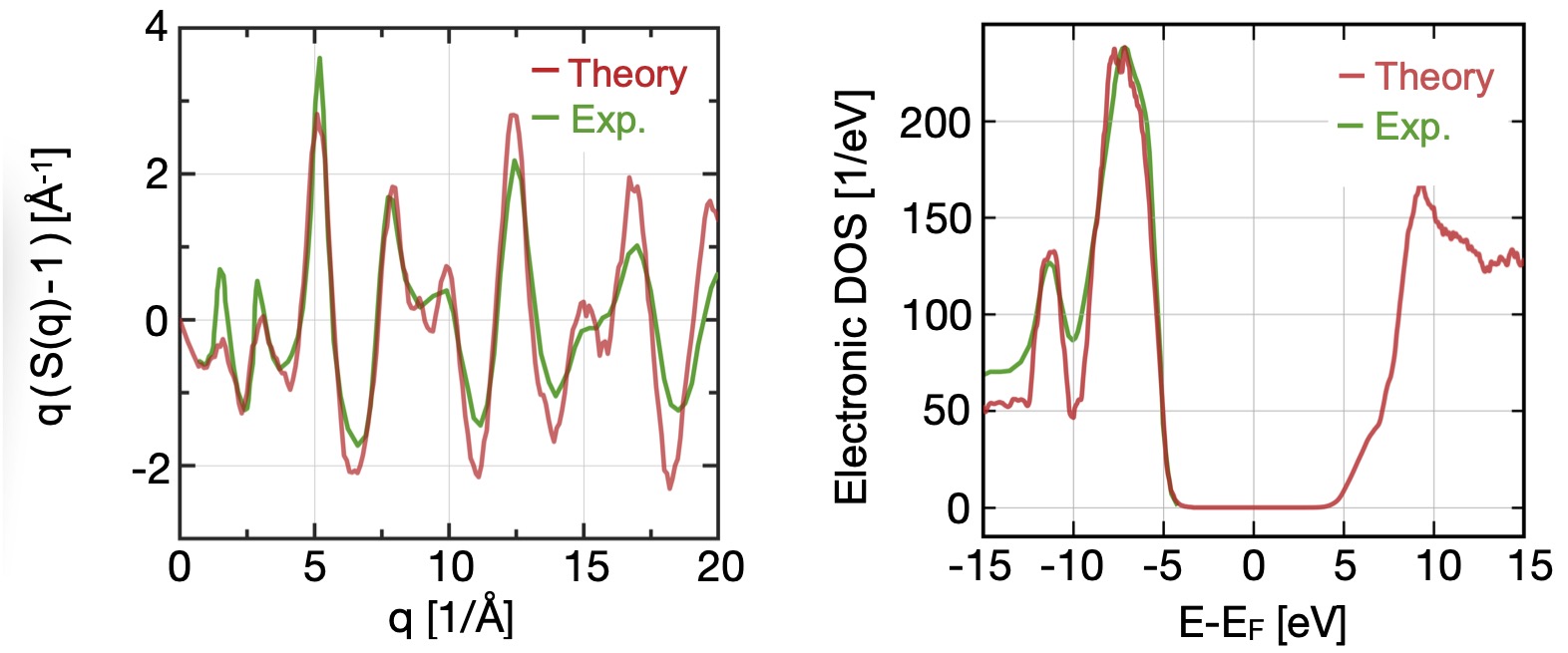 Fig. 1. Model structure factor S(q) and electronic DOS of glassy SiO2 Left panel: Reduced structure factor q(S(q)−1) is compared to a neutron diffraction experiment. Right panel: Model electronic density of states (DOS) for the glassy SiO2 compared to the electronic DOS measured by ultraviolet photoelectron spectroscopy.
Optimization: To make the problem tractable, a smaller representative subset of 50 structures is extracted based on the Pareto optimization method. To best represent the average of the whole set the normalized root mean squared error of the structure factor and absorption coefficient (calculated at the DFT level) was used. This subset of microstates that accurately mimic experimental structure factors and optical absorption profiles.
One-particle Properties: The electronic DOS is evaluated by ensemble-averaging (with Boltzmann weighting) calculations from Quasi-Particle Self-Consistent GW with vertex corrections (QSGŴ) (Fig. 1). Some discrepancy with photoemission experiments are seen in the −15 to −10 eV range. This is due to the broadening of the deep O 2s state from many-body effects, which are discarded in the GW quasi-particlization step.
Optical properties: are evaluated by ensemble-averaging (with Boltzmann weighting) calculations from Quasi-Particle Self-Consistent GW with vertex corrections (QSGŴ) and the Bethe-Salpeter Equation (BSE).
Benchmarks
Both quartz (crystalline SiO2) and glass (amorphous SiO2) are very well described by the model. It reproduces band gaps (8.8–9.7 eV estimated vs. 7.5–9.6 eV experimental), experimental dielectric functions, absorption coefficients, and refractive indices with accuracy comparable to crystalline solids.
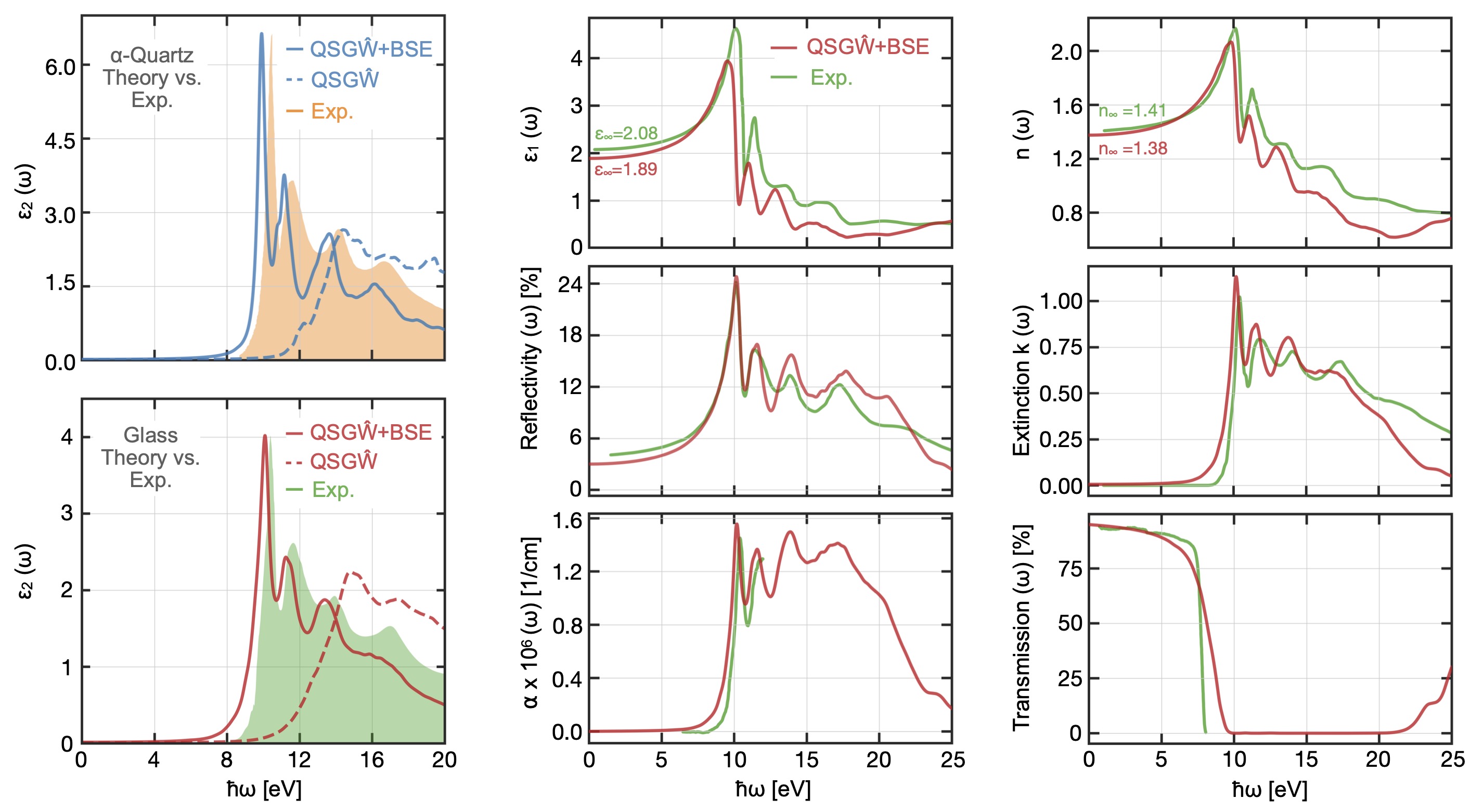 Fig. 2. Optical properties of glassy SiO2. Left: The calculated imaginary part of the dielectric function for α-quartz and glass at the QSGŴ and QSGŴ+BSE level, and a comparison with experiments. Right: derived optical properties for the glassy system and a comparison with experiments.
Excitons in Glassy Silica
The exciton ground states for α-quartz and for the majority of the 50 structures in the subset are found to be effectively dark. Although the oscillator strengths are non-zero for the glassy structures, they are significantly smaller than those associated with the first absorption peak of α-quartz in ε2 at ∼9.9 eV.
However, the amorphous structures motifs (“defects”) not present in α-quartz. We can classify the m and associate excitons with them. Thus, we can divide the composite structures into “Defect-free” structures; those with edge-sharing tetrahedra; those with oxygen dangling bond; and those with O-O/Si-Si bond, and associate excitons with each. This is another significant advantage of our model. Fig. 3(a) shows the “excitonic DOS” — the density of excitonic states in the glassy state. The excitonic DOS is similar to the dielectric function, but omits the optical matrix element. Each exciton, light or dark, receives equal weight.
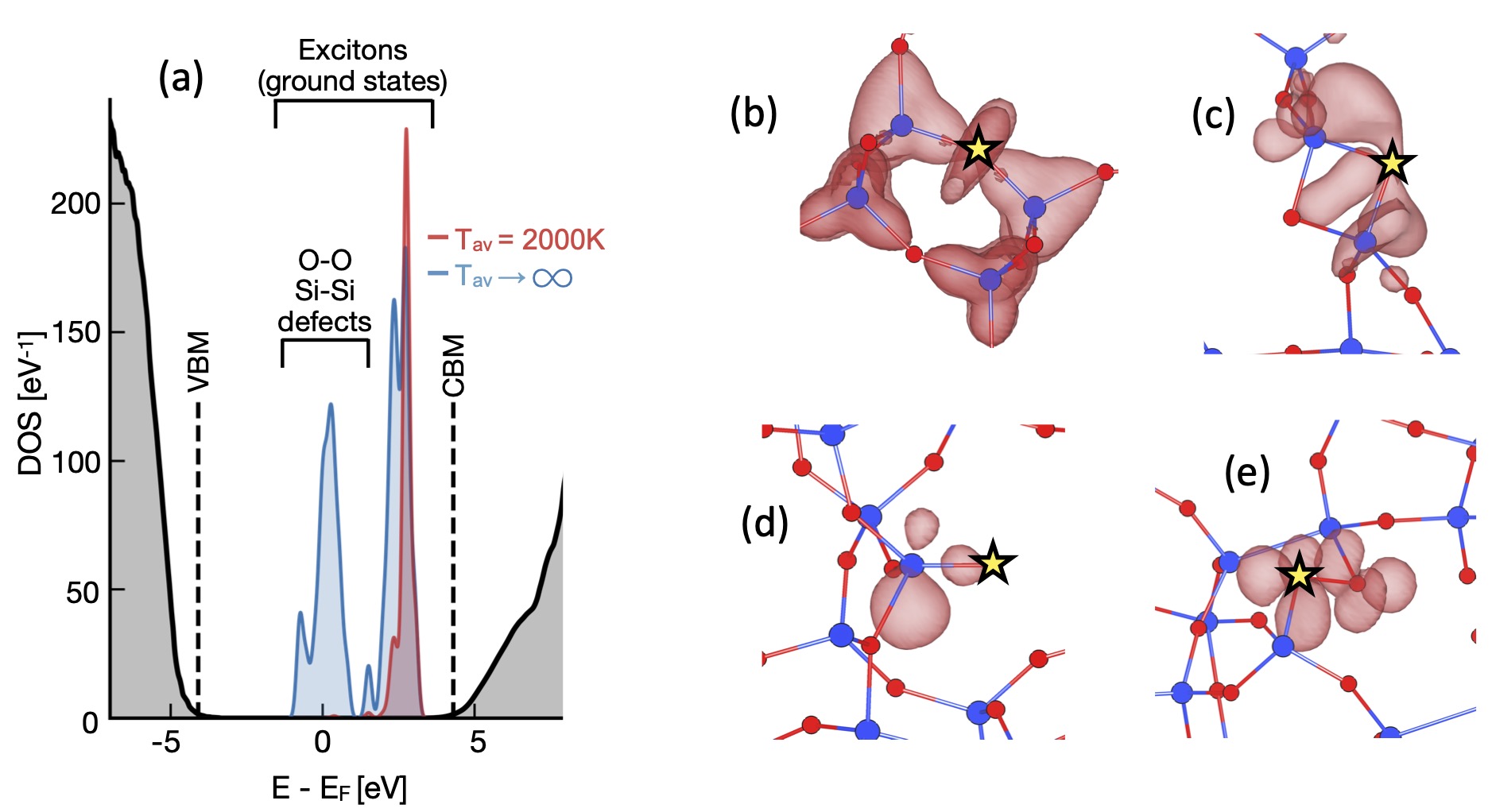 Fig. 3. Properties of excitons in glassy SiO2. (a) Excitonic DOS of the ensemble averaged and high-temperature limit of the glassy structures, displayed on top of the electronic DOS. The excitonic DOS is scaled for clarity. (b) spatial distribution of exciton obtained by fixing the hole on the atom with the highest probability density of finding the hole (indicated by the yellow star) for the subset of structures that are “defect-free.” (c,d,e) same as (b), but for structures with edge-sharing, oxygen dangling bond, and with O-O/Si-Si bonds.
Defect-Free Glass Properties: ground-state (i.e. most deeply bound) excitons in typical quartz-like (corner-sharing SiO4 tetrahedra) regions are mostly dark, localized near oxygen atoms within small 4-member rings. Their radii average (similar to quartz’s ), while their binding energies average , roughly 25% higher than in -quartz.
Structural Defects as Color Centers: Defect motifs (edge-sharing tetrahedra, oxygen dangling bonds, and O–O/Si–Si bonds) strongly localize excitons, producing bright low-energy states, smaller exciton radii (), and significantly higher binding energies ().
Defect-driven absorption peaks emerge at lower energies ( for edge-sharing tetrahedra, for dangling bonds, and for peroxy linkages).
Significance
The study establishes that microscopic structural disorder alone does not drastically change qualitative excitonic behavior compared to crystalline quartz unless point defects are present. Beyond silica, the small-cell ensemble averaging method offers a generalizable strategy to study excitonic and optical properties in other disordered solids.
PAPERS · AMORPHOUS SOLIDS · OPTICAL RESPONSE · QSGW THEORY · BSE